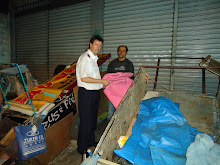
I can hear my footsteps echoing down the nine flights of stairs as I descend from my apartment on the third floor. I walk out of the front door, turn right and walk down the alley past the large exotic plants in the oversized plastic containers welcoming me to the outside world. My key turns with a click in the lock of the towering, metal gate and as I push it outwards my senses are assaulted by the sights and sounds of the Avenida.
The sun shines brightly and I feel the heat on my face. Loud distorted voices announce special offers from loud speakers attached to the top of moving cars, onibus after onibus rattles by pumping thick smoke into the air and I feel the familiar sensation of pollution settling down into the back of my throat. I move from side to side avoiding pedestrians who either do not see me or do not care whether they bump into me or not; they walk at a different pace and a different rhythm to me. Music thumps out of a furniture shop and I can smell sweetcorn and hot dogs mingled with a hint of alcohol from petrol pumping traffic.
And then there is another smell; it is out of place. Amidst the smell of pollution and food stalls the smell of urine is unmistakeable and shocking because it shouldn't be here, on the Avenida. Instinctively, I look for the source of this smell and almost 5o yards along the road I see a dirty, crumpled blanket huddled in a broken down doorway and underneath.....there is a human being, a child of God. I look closer and I see a face but I cannot tell if it is a man or a woman and I am not sure if they are young or old. Poverty has taken away the luxury of identity and they have been reduced to a crumpled blanket in a doorway. This person pulls the blanket over them as if to make themselves more invisible to the crowds who show no interest in them at all.
The Avenida continues to clatter and clang as I walk past but I do not hear it. I am unaware of the pollution in the back of my throat and I no longer hear the men shouting their adverts from the tops of cars as they chug by. What story does this person have to tell? Did they once run and jump as a little child. Did they have hopes and dreams, a favourite food, a best friend, a Mum or a Dad who loved them? I think of Jesus and I wonder where He is in this person's life and then I am reminded that I am part of the body of Christ and this is where God has sent me. I cannot speak the language well enough to approach this person without causing them some concern. I have nothing with me that I can offer as a gift. I say a prayer. What can I do Lord? Show me how I can help? Not just this person, but all the people I see, each day, living in poverty, living without the basic human needs that we take for granted in the western world.
My key turns in the lock of the metal gate. It shuts with a bang and I am now on the other side. It is quieter here but that crumpled blanket continues to invade my senses and disturb my heart as I climb the nine flights of stairs back to my apartment.
Tuesday, August 17, 2010

Saturday, July 10, 2010
Learning portuguese...
A little bit of the language is a dangerous thing....! On Thursday (8th July) P came back from the office at lunch-time and announced that the house next door to The Salvation Army hall was up for sale. I was so excited - every time I walk past that house I pray that we will be able to buy it one day (I also pray for the land behind the hall as well). I went round to the house in the afternoon and got a telephone number. One of our soldiers phoned the owner on Friday and sent a disappointing e-mail to us. Apparently, we had completely misunderstood the sign - they are selling a mobile home and not their house. This isn't the first time we have got things wrong.
On 26th June we were invited to a wedding. It was a lovely way to spend our own 11th wedding anniversary. After the service we spoke to the father of the groom. I said to P wouldn't it be good if we could say something like, 'You must be so proud of your son'. We try to keep conversation simple as we are not at all fluent in portuguese yet. P was confident he knew the word for 'proud' so he spoke to the father of the groom who gave him a strange look and said, 'No' in a kind of embarrassed manner. Fortunately, P realised that he had got his words muddled up and correcting his portuguese spoke again to the father of the groom who then looked very pleased and agreed wholeheartedly. I am so relieved P was able to correct his mistake because he had originally said, 'You must be very ashamed of your son' - which would explain the rather gracious but embarrassed response.
This week we have applied to start a portuguese language course in Sao Paulo.
On 26th June we were invited to a wedding. It was a lovely way to spend our own 11th wedding anniversary. After the service we spoke to the father of the groom. I said to P wouldn't it be good if we could say something like, 'You must be so proud of your son'. We try to keep conversation simple as we are not at all fluent in portuguese yet. P was confident he knew the word for 'proud' so he spoke to the father of the groom who gave him a strange look and said, 'No' in a kind of embarrassed manner. Fortunately, P realised that he had got his words muddled up and correcting his portuguese spoke again to the father of the groom who then looked very pleased and agreed wholeheartedly. I am so relieved P was able to correct his mistake because he had originally said, 'You must be very ashamed of your son' - which would explain the rather gracious but embarrassed response.
This week we have applied to start a portuguese language course in Sao Paulo.
Tuesday, July 6, 2010
Day trip to Niteroi
When I wrote my last blog on May 6th I had no idea that I would have the opportunity to meet some of the survivors of the disaster in Niteroi, Rio de Janeiro. A few weeks ago I was invited to attend a training course called, 'Developing Tools for work in the Community' and during the week we spent a day in Niteroi. My group visited an old barracks where 415 people from Bumba (the favela that experienced the mud slides and gas explosion in April) are currently living until they are re-housed in more permanent accommodation which the government has promised to provide.
While I was there I had the opportunity to talk with a lady, J, who was sitting on the steps of one of the accommodation blocks. E and P were with me and P helped me with translation. I learnt that just providing shelter, food and toiletries is not sufficient although it is a good place to start. Each family living there is given R$ 400 a month from the government. They do not need to pay rent and all their meals are provided. This may sound like a good deal to western ears but living in community brings with it many issues. They have to eat meals together at set times and one of my colleagues spoke to a man whose work (taxi driver) meant that he often missed meals and without a kitchen of his own he was not able to cook his own meal.
J was worried about safety for her 11 year old adopted daughter and she said that she felt more secure living in her house on the favela than she does living in this community. She has considered returning to her home because only half of it was destroyed - the other half is still standing. She still feels very sad and often cries. She thinks about the children who died whilst waiting for their parents to collect them from the school - the children who were collected early are still alive. On that day J was at the bar with her husband when someone came and told her that somethng had happened to her house. Before the disaster happened she had told her friend that she thought something bad was going to happen and after the mudslide her friend remembered this. She said that she believed in God so we prayed with her before we left. After the prayer she thanked us for listening to her story and she asked if someone could come back to see her. This is possible because the officers and soldiers of Niteroi Corps were heavily involved in the emergency operation and have a long term goal to work with this community. On the same day we had the privilege of attending a public ceremony with the Fire Department where the DC of the Rio de Janeiro Division received a medal on behalf of The Salvation Army for the work of supporting the emergency services at the disaster area.
Please pray that God will open doors into this community for Niteroi Corps and please pray for J and the 415 people living in temporary accommodation.
While I was there I had the opportunity to talk with a lady, J, who was sitting on the steps of one of the accommodation blocks. E and P were with me and P helped me with translation. I learnt that just providing shelter, food and toiletries is not sufficient although it is a good place to start. Each family living there is given R$ 400 a month from the government. They do not need to pay rent and all their meals are provided. This may sound like a good deal to western ears but living in community brings with it many issues. They have to eat meals together at set times and one of my colleagues spoke to a man whose work (taxi driver) meant that he often missed meals and without a kitchen of his own he was not able to cook his own meal.
J was worried about safety for her 11 year old adopted daughter and she said that she felt more secure living in her house on the favela than she does living in this community. She has considered returning to her home because only half of it was destroyed - the other half is still standing. She still feels very sad and often cries. She thinks about the children who died whilst waiting for their parents to collect them from the school - the children who were collected early are still alive. On that day J was at the bar with her husband when someone came and told her that somethng had happened to her house. Before the disaster happened she had told her friend that she thought something bad was going to happen and after the mudslide her friend remembered this. She said that she believed in God so we prayed with her before we left. After the prayer she thanked us for listening to her story and she asked if someone could come back to see her. This is possible because the officers and soldiers of Niteroi Corps were heavily involved in the emergency operation and have a long term goal to work with this community. On the same day we had the privilege of attending a public ceremony with the Fire Department where the DC of the Rio de Janeiro Division received a medal on behalf of The Salvation Army for the work of supporting the emergency services at the disaster area.
Please pray that God will open doors into this community for Niteroi Corps and please pray for J and the 415 people living in temporary accommodation.
Thursday, May 6, 2010
Living on a rubbish dump
Last Wednesday P, A and I travelled into the city of Sao Paulo by train. It is a 2 hour journey with 3 different changes which we have done before. However, this journey was different because at a certain point the train slowed down and because we were sitting by a window we were able to see what was outside.
There was rubbish piled up high against the bank of the railway track. We were passing a massive rubbish dump that continued along the track for about half a mile. Looking more closely I could see people on top of the rubbish scavenging for something which might be of use to them. As the train continued slowly along we noticed that small structures had been built out of wood, corrugated iron and some even of brick. I looked across the carriage to where P. was sitting to see if he had noticed that we were passing a favela built on a rubbish dump and he had.
There were children playing amongst the debris, washing hanging to dry and all the usual signs of a community but they were living on a rubbish dump. It is a dangerous place to live.
The week after Easter Rio de Janeiro experienced as much rain in a few hours as it was expecting in a month. The result was massive flooding and mud slides in different parts of the city. However, in Niteroi, a favela that had been built on a disused rubbish dump had suffered a worse fate. The gases contained deep within the rubbish below had become compressed and then exploded leaving an enormous hole where the community had lived. Deep within that hole were the remains of numerous houses, a church where a service had been taking place and a school where many children were attending an after school club. After a massive rescue operation there are still 54 people missing.
A Salvation Army team from the Sao Paulo Division and Rio were on site almost immediately, greatly aided by the fact that there was already a Salvation Army Corps in the area. They served rescue services with refreshments, counselled the bereaved at the makeshift morgue, facilitated donations and liased with the media.
Paul and I were on holiday at the time but we saw some of our colleagues from THQ on the TV news reports.
You can find more information about the work of The Salvation Army in Rio de Janeiro during this crisis on the Brazilian Salvation Army website: http://www.exercitodesalvacao.org.br/
There was rubbish piled up high against the bank of the railway track. We were passing a massive rubbish dump that continued along the track for about half a mile. Looking more closely I could see people on top of the rubbish scavenging for something which might be of use to them. As the train continued slowly along we noticed that small structures had been built out of wood, corrugated iron and some even of brick. I looked across the carriage to where P. was sitting to see if he had noticed that we were passing a favela built on a rubbish dump and he had.
There were children playing amongst the debris, washing hanging to dry and all the usual signs of a community but they were living on a rubbish dump. It is a dangerous place to live.
The week after Easter Rio de Janeiro experienced as much rain in a few hours as it was expecting in a month. The result was massive flooding and mud slides in different parts of the city. However, in Niteroi, a favela that had been built on a disused rubbish dump had suffered a worse fate. The gases contained deep within the rubbish below had become compressed and then exploded leaving an enormous hole where the community had lived. Deep within that hole were the remains of numerous houses, a church where a service had been taking place and a school where many children were attending an after school club. After a massive rescue operation there are still 54 people missing.
A Salvation Army team from the Sao Paulo Division and Rio were on site almost immediately, greatly aided by the fact that there was already a Salvation Army Corps in the area. They served rescue services with refreshments, counselled the bereaved at the makeshift morgue, facilitated donations and liased with the media.
Paul and I were on holiday at the time but we saw some of our colleagues from THQ on the TV news reports.
You can find more information about the work of The Salvation Army in Rio de Janeiro during this crisis on the Brazilian Salvation Army website: http://www.exercitodesalvacao.org.br/
Saturday, April 24, 2010
One warm, dry evening.
Every Tuesday evening we hold a prayer meeting at the hall between 8 - 9pm. Between 20 - 30 people come along and some come stright from work. It was a warm, dry evening last Tuesday (20th April) so I was able to stand at the entrance gate to our hall and give out copies of the Rumo (the Brazilian War Cry) to passers by.
I gave away 50 copies and not one person said, 'No thank you'. During the course of the evening I noticed a young woman (aged between 19 - 22 years old) walking by on the other side of the road dressed in shorts and a t-shirt. While I was wondering whether to cross the road and give her a Rumo she also caught the attention of 3 young men in a car. The car stopped suddenly in the middle of the road right outside the Salvation Army hall and one of the men called out to her. She threw back a comment and continued walking. I watched as the driver reversed the car up the road and continued to talk to her. I wasn't aware of whether she knew the men or not but at this point I became concerned for her. I prayed that she wouldn't get into the car.
The young woman continued to walk in the same direction and the driver then turned the car around in a junction and pulled up next to her about 300 yards from where I was standing. The young woman stopped and there was a conversation between her and the young men.
I wasn't sure whether she was in a vulnerable position or not but I felt that I couldn't just watch and do nothing. So, I walked up the road to where they were talking and asked the young woman if she would like a Rumo. She took a copy of the magazine and I gave one each to the young men in the car. I turned again to the girl and said, 'Tudo bem?' (everything ok?) and she said, 'Tudo' (everything). By now she was sitting on a low wall and smoking a cigarette. So, I walked back to the Salvation Army hall and when I looked back I noticed that the car had gone and the young woman was sitting on the low wall......reading the Rumo!
I gave away 50 copies and not one person said, 'No thank you'. During the course of the evening I noticed a young woman (aged between 19 - 22 years old) walking by on the other side of the road dressed in shorts and a t-shirt. While I was wondering whether to cross the road and give her a Rumo she also caught the attention of 3 young men in a car. The car stopped suddenly in the middle of the road right outside the Salvation Army hall and one of the men called out to her. She threw back a comment and continued walking. I watched as the driver reversed the car up the road and continued to talk to her. I wasn't aware of whether she knew the men or not but at this point I became concerned for her. I prayed that she wouldn't get into the car.
The young woman continued to walk in the same direction and the driver then turned the car around in a junction and pulled up next to her about 300 yards from where I was standing. The young woman stopped and there was a conversation between her and the young men.
I wasn't sure whether she was in a vulnerable position or not but I felt that I couldn't just watch and do nothing. So, I walked up the road to where they were talking and asked the young woman if she would like a Rumo. She took a copy of the magazine and I gave one each to the young men in the car. I turned again to the girl and said, 'Tudo bem?' (everything ok?) and she said, 'Tudo' (everything). By now she was sitting on a low wall and smoking a cigarette. So, I walked back to the Salvation Army hall and when I looked back I noticed that the car had gone and the young woman was sitting on the low wall......reading the Rumo!
Saturday, March 27, 2010
Keeping my eyes open.
Not long after we were married I told my husband, P, that when I was a cadet on my Summer Placement that God had called me to work in Brazil. P said, ´Now you tell me! Why didn´t you mention this before!´ The truth was that I hadn´t thought about it since then. 8 years ago I had returned to the college after my Summer Placement and shared my thoughts about Brazil with my Sectional Officer. He told me that I should work in the UK and I breathed a sigh of relief! I thought no more about it until P and I were working in our first married appointment in Erskine, West Scotland. I wondered whether my thoughts had turned to warmer climes because I was feeling a bit chilly, so together P and I sought guidance from God. Many, many times God confirmed that He wanted us both to work for The Salvation Army in Brazil and so P became as convinced as I was that God had put a massive signpost in front of us pointing in the direction of Brazil. However, not once did God tell us why He wanted us to go or what we would do when we got here.
As we are approaching our 11th wedding anniversary we find ourselves here in Brazil working in the Corps at Sao Miguel Paulista. We were both thrilled and amazed to receive this appointment; thrilled because we love working in Corps and amazed because we can´t speak portuguese! God has still not given us any word about why he has sent a girl from Basingstoke and a boy from Pompey to work here but He has given me one very clear instruction, ´Keep your eyes open´. I was sitting on the platform waiting to preach in our Welcome Meeting last August when I felt God say this to me. So, I have tried to do this in a literal sense in every meeting.
Yesterday, I was walking through the market on the way to the Post Office to collect a parcel (see photos below) when I passed a makeshift shelter made from a large umbrella and bits of cardboard. A major thunderstorm had just ended and the multicoloured umbrella caught my attention. The answer came before I even asked the question, ´Keep your eyes open´. It felt like God was talking to me again and then I asked Him, ´What are we to do here?´
I once had a DC who said, ´The call is often seeing the need´. He had spent some years working in the Caribbean. It occurs to me that God has taken the trouble to write down what He wants us to do in the Bible and Jesus was kind enough to share His manifesto at the synagogue in Nazareth (Luke 4). I probably don´t need God to tell me why I am here, I just need to keep my eyes open, see what needs doing and do it!
As we are approaching our 11th wedding anniversary we find ourselves here in Brazil working in the Corps at Sao Miguel Paulista. We were both thrilled and amazed to receive this appointment; thrilled because we love working in Corps and amazed because we can´t speak portuguese! God has still not given us any word about why he has sent a girl from Basingstoke and a boy from Pompey to work here but He has given me one very clear instruction, ´Keep your eyes open´. I was sitting on the platform waiting to preach in our Welcome Meeting last August when I felt God say this to me. So, I have tried to do this in a literal sense in every meeting.
Yesterday, I was walking through the market on the way to the Post Office to collect a parcel (see photos below) when I passed a makeshift shelter made from a large umbrella and bits of cardboard. A major thunderstorm had just ended and the multicoloured umbrella caught my attention. The answer came before I even asked the question, ´Keep your eyes open´. It felt like God was talking to me again and then I asked Him, ´What are we to do here?´
I once had a DC who said, ´The call is often seeing the need´. He had spent some years working in the Caribbean. It occurs to me that God has taken the trouble to write down what He wants us to do in the Bible and Jesus was kind enough to share His manifesto at the synagogue in Nazareth (Luke 4). I probably don´t need God to tell me why I am here, I just need to keep my eyes open, see what needs doing and do it!
Tuesday, March 9, 2010
Preferential treatment
Last week I decided to take A. shopping with me. I was a bit concerned about whether he would slow me down and whether I would get back to the apartment in time to have lunch and take him to school at 13:30. I really didn't need to worry. In Brazil they have something called preferential treatment so if you are elderly, disabled, pregnant or have a small child with you, you will always be able to go to the front of the queue, sit down on the bus or train or be served at a special counter. So, as I walked into the Post Office I was very surprised to see that there was no-one else in the queue (very unusual!) but even better than that, as soon as I stood at the front of the queue I was called over to a special counter where I was served immediately. I really think I should take A. shopping with me more often!
So, because we had some extra time on our hands we were able to buy some birthday presents for Daddy and have a look at some televisions. Last year we bought a Brazilian TV in a Brazilian Makro and P. has enjoyed watching premiership football on it and I have enjoyed watching the occasional film. However, two weeks ago our apartment block was hit by lightning. I was at the Hall for a prayer meeting that had just ended and we heard an enormous bang - like a bomb going off. We have alot of tropical thunderstorms here, practically every day in the summer months, so I thought it was a particularly loud thunder clap. However, when I got back to the apartment I found that P. was in the bedroom as the light in the living room was no longer working. He told me that the apartment block had been hit by lightning and the other casualty had been our TV. Fortunately, we insured it with SAGIC and our policy covers lightning. Yesterday, the light fitting was repaired and today P. took the TV to a repair shop. This is life in Brazil - there is always something to be repaired or fitted or organised and because we are so new here it takes us a long time to find out where we need to go or what we have to do. It is a great adventure!
So, because we had some extra time on our hands we were able to buy some birthday presents for Daddy and have a look at some televisions. Last year we bought a Brazilian TV in a Brazilian Makro and P. has enjoyed watching premiership football on it and I have enjoyed watching the occasional film. However, two weeks ago our apartment block was hit by lightning. I was at the Hall for a prayer meeting that had just ended and we heard an enormous bang - like a bomb going off. We have alot of tropical thunderstorms here, practically every day in the summer months, so I thought it was a particularly loud thunder clap. However, when I got back to the apartment I found that P. was in the bedroom as the light in the living room was no longer working. He told me that the apartment block had been hit by lightning and the other casualty had been our TV. Fortunately, we insured it with SAGIC and our policy covers lightning. Yesterday, the light fitting was repaired and today P. took the TV to a repair shop. This is life in Brazil - there is always something to be repaired or fitted or organised and because we are so new here it takes us a long time to find out where we need to go or what we have to do. It is a great adventure!
Subscribe to:
Posts (Atom)